Fundamentals
Blockchain
A blockchain is a chain of blocks forming a distributed database to which data can only be appended.

A traditional database runs on servers belonging to a single company. For example, if a bank decides to change your account balance, it technically has the ability to do so.
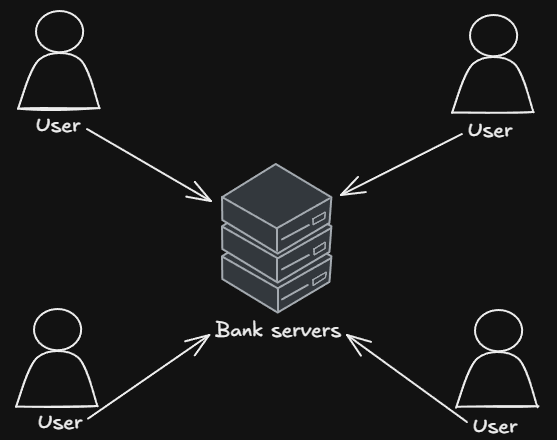
A blockchain works differently:
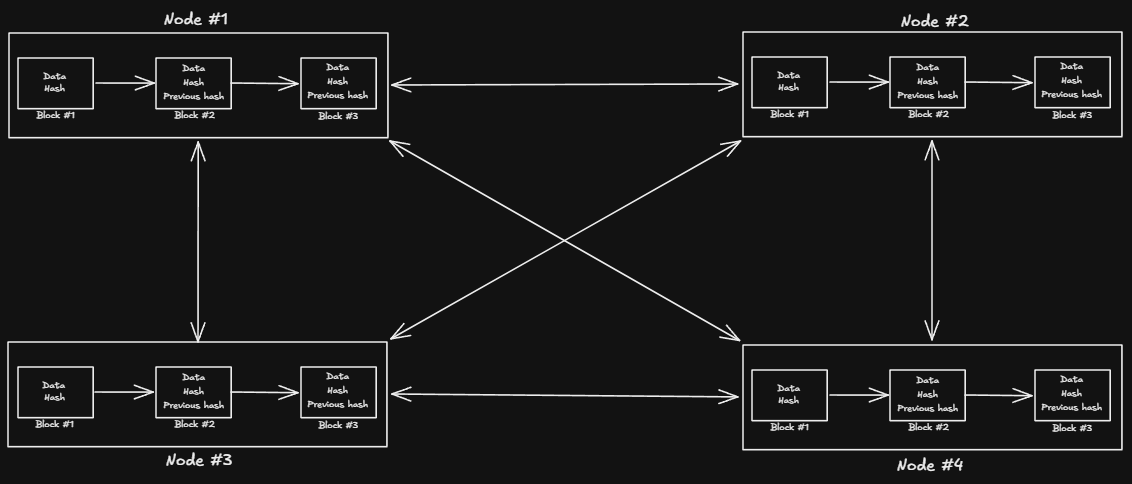
- Decentralization: Copies of the entire database are held by thousands of independent nodes around the world.
- Blocks and hashing: Transactions are grouped into batches called blocks. Each new block contains a digital fingerprint (
hash) of the previous one. This creates a chain whose earlier data can easily be checked for tampering. - Immutability: If someone tried to falsify a transaction from a year ago, that block's hash would change, invalidating all subsequent blocks in the chain. Other nodes would detect the violation of the network's rules and reject the invalid version of the chain.
Key concepts
Smart contracts
A smart contract is a program implemented directly on a blockchain that executes automatically when its predefined conditions are met.
A smart contract follows a simple rule: if event X occurs, perform action Y.
Different ecosystems: On EVM networks, such as Ethereum, smart contracts are primarily written in Solidity. In the Solana ecosystem, smart contracts, known simply as programs, are most commonly written in Rust using the Anchor framework.
DeFi
DeFi stands for decentralized finance and also refers to the entire ecosystem of financial applications (dApps) built on smart contracts.
Its goal is to recreate and improve services familiar from traditional finance, such as loans, deposits, and currency exchange, without involving centralized institutions.
Many DeFi protocols have no identity verification (KYC) requirements or opening hours.
They operate 24/7, and all you need to use a service is a wallet with network access and funds to cover transaction fees.
NFTs
An NFT (Non-Fungible Token) is a unique token recorded on a blockchain that cannot be substituted one-for-one with another token of the same type.
While an ordinary token, such as USDC or SOL, is fungible — your 1 USDC has exactly the same value as someone else's 1 USDC — each NFT has its own unique identifier (Token ID) and associated metadata.
NFTs are most commonly used to digitally certify ownership, from images, artwork, and in-game items to digital tickets and domain names such as .sol.
Networks
Layer 1 (L1)
In crypto, a layer 1 network is a distinct, independent blockchain ecosystem. Each network operates under its own rules, with separate validators, its own execution environment, different block times, and its own fees.
The most popular networks include Bitcoin, Ethereum, and Solana.

Key characteristics of these networks:
- No native compatibility: These networks are isolated from one another. You cannot send Bitcoin directly to a Solana or Ethereum address: they use completely different protocols and address formats.
- Transaction fees (
gas fees): Every operation on a network must be paid for in its native coin. When transferring anything on Ethereum, you pay inETH; when making a transaction on Solana, you pay inSOL. - Bridges: Bridges are used to move value between different networks. They typically work by locking your funds on network
Aand issuing a synthetic representation, orwrapped token, on networkB.
An important rule: When making transfers from an exchange or another wallet, make sure the selected destination network matches on both sides. Choosing the wrong network, such as sending EVM-standard tokens to a Solana address, will most likely result in the permanent loss of funds.
Layer 2 (L2)
Over the years, popular layer 1 networks such as Ethereum have encountered scaling problems.
When too many people use them at once, the network becomes congested, and transaction fees (gas fees) can jump to absurd amounts of tens of dollars for a single transfer.
Layer 2 is an architecture built on top of an existing L1 blockchain to take on the burden of executing transactions while preserving the security of the main network.

How L2 works:
- Processing off the main chain: You place your funds on an
L2network, such as Arbitrum, Optimism, or Base. Transactions execute almost instantly and usually cost much less than transactions directly onL1. - Batching: The L2 collects many transactions, processes them off the main chain, and publishes data or information on
L1that allows their execution to be verified. - Settlement on L1: The L2's results are then anchored to Ethereum, and the mechanisms of that particular L2 allow the validity of transaction execution to be verified or challenged.
Coin vs. token
Coin
A coin is a network's native currency, supported directly by its protocol.
- Role: It rewards validators for maintaining the network and serves as the transaction fee (
gas fee) for performing any operation on that network. - Examples: BTC on Bitcoin, ETH on Ethereum, and SOL on Solana.
Token
A token does not have its own blockchain. It is an asset issued and managed by a program or smart contract running on an existing L1 or L2 network.
- Role: It can represent anything, such as a digital equivalent of the dollar: a
stablecoin. - Examples: USDT (
Tether) and USDC.
Wallets
What is a wallet?
Contrary to a common misconception, a crypto wallet does not contain any coins or tokens.
Your cryptocurrencies always reside on the blockchain as records in a distributed database. A crypto wallet is simply an interface, such as a browser extension or mobile app, that manages your cryptographic keys and lets you send transactions signed with your digital identity.
Popular software wallets include Phantom and Solflare.
For those seeking the highest level of security, hardware wallets such as Ledger and Trezor are also available.
How do you create a wallet?
The easiest way to create your own crypto wallet is to use a browser extension or mobile app:
- Download the official browser extension, such as Phantom or Solflare, or the mobile app.
- Depending on the application, select an option such as Create a new wallet.
- Set a local password. It is used only to unlock the application on your device.
- Write down the recovery phrase (
seed phrase) displayed by the application on paper. If you lose your seed phrase, you lose access to the funds in your wallet!
However, generating a wallet does not require an application or a network connection. The entire process is based on the open BIP-39 standard.
Alternatively, you can download an official generator script, such as Ian Coleman's open-source bip39-standalone.html, disconnect from the internet, and generate a valid seed phrase and key pair entirely offline.
Sub-wallets
Modern wallets use the HD (Hierarchical Deterministic) standard.
This means that a single main recovery phrase can generate a virtually unlimited number of sub-wallets, or accounts.
Each sub-wallet has its own unique public address and private key, but all are derived directly from your main seed.
Benefits of using sub-wallets:
- Risk separation: You can use one sub-wallet to hold savings and another to transact online.
- Privacy: Using different addresses makes it harder to link all your activity into a single public profile.
Wallet security
Seed phrase
A recovery phrase (seed phrase) is a sequence of 12 or 24 words from the BIP-39 wordlist, which contains exactly 2,048 words.
It is a representation of entropy from which BIP-39 generates a seed, which is then used to derive wallet keys.
The words are chosen so that the first four letters of each word uniquely identify the whole word.
An example of a 12-word recovery phrase looks like this:
practice easy increase view desert mirror move crime nose junk identify joy
This recovery phrase is only an example. Never send funds to addresses associated with publicly available phrases!
Key rules for protecting your recovery phrase:
- Never enter your seed into websites: No official
dApp, support team, or exchange will ever ask you for your seed phrase. - Store it offline: Write the words on paper. Do not take photos or store them in the cloud or in files on your computer.
- Anyone with your seed phrase has full control over all your funds!
Private key
A private key is a unique string generated from the seed phrase for each individual sub-wallet.
It is used to mathematically sign transactions. When you send a transfer, your wallet uses the private key to generate a cryptographic signature. Network nodes verify this signature and confirm that you are authorized to spend the funds at that address.
Public key
A public key and the wallet address based on it are derived from a private key using a one-way mathematical function.
It is the equivalent of your bank account number (IBAN): it is public, and you share it with others to receive transfers or check your history in a block explorer.
Public key vs. wallet address
Although these terms are used interchangeably in everyday conversation, there is a technical distinction:
- Public key: The raw public key generated from a private key.
- Wallet address: The format a network uses to identify an account. In some systems, it is directly associated with the public key.
Because these mathematical functions are one-way, neither an address nor a public key can be used to reconstruct the private key.
Exchanges
CEX
A CEX (centralized exchange) is a traditional trading platform managed by a company, such as Binance or Coinbase.
It operates much like a conventional broker or bank: you create an account, complete identity verification (KYC), and deposit traditional currency (fiat), such as PLN or EUR, to buy cryptocurrency.
Why shouldn't you keep funds on a CEX?
When you buy cryptocurrency on a centralized exchange, it does not go directly into your private crypto wallet. Instead, the exchange credits your internal balance with the corresponding digital amount, while the coins themselves are held in pooled wallets belonging to the exchange.
A fundamental principle in crypto is Not your keys, not your coins: if you do not have the keys, you do not have the coins.
Keeping funds on a CEX carries specific risks:
- No actual control: The funds are controlled by the exchange, because it controls the keys to the wallets holding the assets. If the exchange becomes insolvent, users lose access to their money.
- Account freezes: The exchange operator can freeze your account or suspend withdrawals at any time because of legal requirements, system failures, or its own policies.
Centralized exchanges are a great place to convert traditional currencies into crypto, but they should serve only as a gateway from TradFi, rather than a secure vault for savings.
DEX
A DEX (decentralized exchange) allows users to exchange tokens directly with one another without any intermediary.
Instead of a company managing the transaction ledger, all trading logic on a DEX is based on smart contracts and liquidity pools.
Key characteristics of a DEX:
- Self-custody: To use a decentralized exchange, you connect directly from your private wallet.
- No KYC: You do not need to create an account, provide an email address, or submit a scan of your identity document. Anyone with a funded crypto wallet to cover transaction fees can trade.
Privacy
Anonymity or pseudonymity?
Many people associate cryptocurrencies with complete anonymity, but in reality, most popular blockchains are among the most public transaction systems in existence. Every transaction is publicly visible and linked to your public address.
- Pseudonymity: Your identity on the network is your public wallet address, such as
4cTH.... As long as nobody knows who owns an address, you remain relatively anonymous. - Linking identities: When you transfer funds from a CEX, where you completed identity verification (
KYC) using an identity document, to your private wallet, the exchange and analytics companies can associate your public wallet address with your identity. From that point on, your wallet's entire history is visible to them.
Solscan, Etherscan, Mempool - transaction history
Because a blockchain is a public, transparent database, anyone can analyze the history of any address.
Block explorers are used to browse this data:
- mempool.space: For Bitcoin.
- etherscan.io: For Ethereum and EVM ecosystems.
- solscan.io: For Solana.
If someone learns your public address, they can paste it into an explorer and inspect your entire transaction history from the first day of the wallet's existence, along with your current balance!
Monero (XMR)
If conventional blockchains are completely transparent, what about true privacy? The answer is privacy coins, with Monero (XMR) being one of the best-known privacy-focused projects.
Unlike Bitcoin, Ethereum, and Solana, Monero hides the sender, recipient, and transaction amount at the protocol level.
In a Monero block explorer, you will not see any amounts or addresses. Because of this uncompromising privacy, Monero continues to be delisted from many centralized exchanges under pressure from financial regulators.
Technical details
Transaction validation mechanisms
For a distributed network of nodes around the world to continuously agree on a single, true database state, it needs a consensus algorithm.
Proof of Work
The pioneering mechanism known from Bitcoin. Miners compete by performing enormous numbers of calculations to find a valid cryptographic solution.
- Advantages: Extremely strong security, a proven record of resistance to attacks, and a high degree of decentralization.
- Disadvantages: Enormous electricity consumption and low transaction throughput due to long block times.
Proof of Stake
A more modern mechanism used by Ethereum and most new L1 networks.
Instead of consuming electricity and buying hardware, validators lock up their own coins on the network as collateral (stake).
- Mechanics: In many
PoSimplementations, a larger stake increases a validator's weight in block selection or transaction confirmation. - Penalties: If a validator tries to cheat the network, for example by approving a fraudulent transaction or signing two different blocks at once, part of its locked coins is permanently destroyed.
Execution architecture: EVM vs. Solana
The difference in how data is processed is the main reason why EVM networks and Solana behave so differently from a user's perspective.
The EVM model
An EVM smart contract contains code and its own persistent storage, where it can store application state.
- Tokens, such as
ERC-20: A single smart contract, such as the one forUSDT, holds a huge list of addresses and their balances in its own storage. - Bottleneck: Because transactions constantly modify the same smart contract, the EVM processes them mainly sequentially, leading to high transaction fees (
gas fees) under heavy load.
The Solana model
Solana takes a different approach. Solana programs contain only logic: they do not hold data or balances themselves.
- Separation: Program code resides in one place, while user data resides in external accounts.
- Parallelism: A transaction must declare in advance which accounts it will access. This allows the network to process thousands of transactions in parallel, as long as they are not modifying the exact same account at the same time.
SPL
SPL (Solana Program Library) is a collection of standards and programs used in the Solana ecosystem, including those for creating and managing tokens.
It is the functional equivalent of token standards on Ethereum, such as ERC-20.
ATA
An Associated Token Account (ATA) is a special account for tokens other than native SOL.
Creating one requires depositing a reserve in SOL to make the account rent-exempt.
The reserve can be recovered when the account is closed.